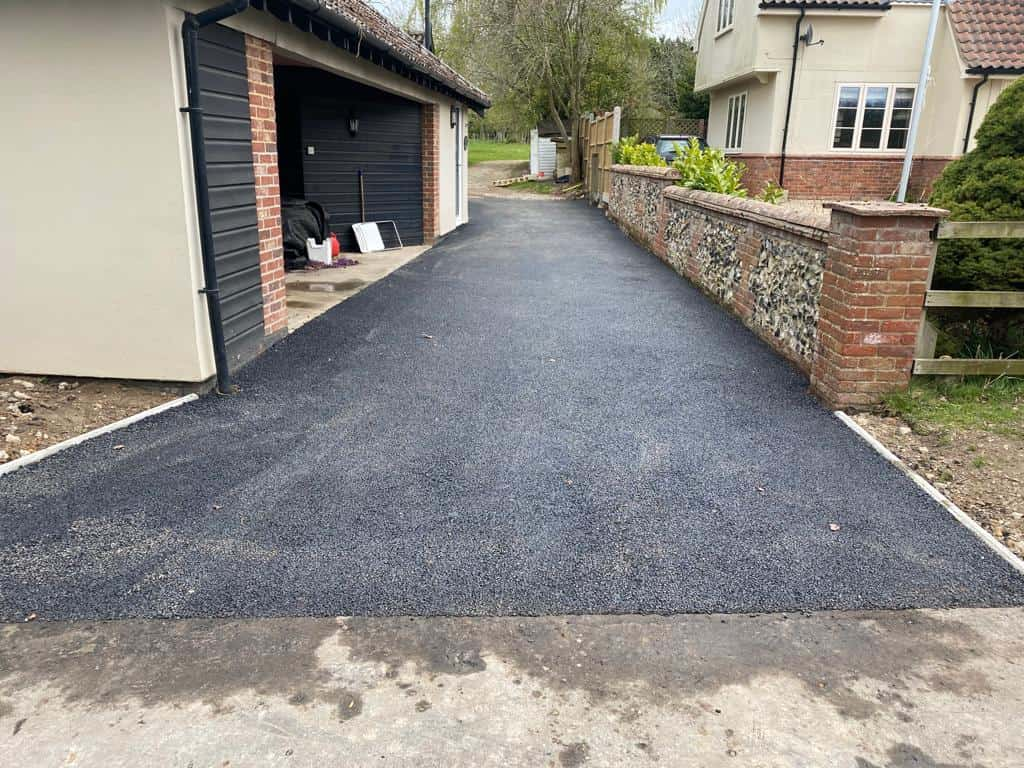
Is Tar and Chip Suitable for a Driveway with Several Parking Areas?
A driveway that needs to accommodate several vehicles requires more planning than a simple access route leading to a single parking space. Vehicle movements, turning areas, regularly occupied parking positions and the way different sections connect can all influence how well the finished surface performs.
Tar and chip can be a practical option for larger driveway layouts because it creates a continuous, textured surface that can extend across access routes and multiple parking areas. However, its suitability depends on much more than the visible finish. The supporting construction, drainage, edge details and expected vehicle movements all need to be considered.
For homeowners in Gravesend, Kent, assessing the complete layout before surfacing is particularly important when several parking spaces need to function as one coordinated driveway.
Can Tar and Chip Work Well Across Multiple Parking Spaces?
Yes, tar and chip can be suitable for a driveway containing several parking areas when the complete surface is properly designed and prepared for its intended use.
The material can cover relatively broad areas without requiring the driveway to be divided into individual paving units. This can help access routes, turning spaces and parking positions appear visually connected.
The key consideration is the construction underneath. A larger driveway may experience different loading patterns across different sections, so the foundation and surface preparation need to provide suitable support throughout the complete area.
A Larger Driveway Needs to Be Planned as One Surface
Where several cars are regularly parked, it is easy to think about each parking space separately.
In practice, the vehicles also need to reach those spaces. This means the driveway contains access routes, turning points, reversing areas and sections where tyres repeatedly follow similar paths.
These movement areas can experience more frequent loading than the places where vehicles simply remain parked.
A good surfacing plan therefore considers how the entire driveway will be used rather than concentrating only on the dimensions of individual parking spaces.
Tar and Chip Can Create Visual Continuity
One advantage of tar and chip is its ability to create a consistent finish across a larger outdoor area.
When a driveway contains several separate parking sections, too many changes in surface material can sometimes make the layout appear fragmented.
Using one continuous tar and chip finish can help connect the different areas visually.
The textured aggregate appearance can also suit larger spaces because it provides natural variation across the surface rather than creating an excessively uniform expanse.
The Base Must Support Repeated Vehicle Loading
The appearance of a driveway is determined by its upper surface, but much of its performance depends on the construction underneath.
A driveway with several parking spaces may experience substantial daily vehicle movement. If the underlying base contains weak or poorly compacted sections, problems can eventually become visible at the surface.
Depressions, movement and localised deterioration can develop where support is inadequate.
Professional preparation therefore focuses on creating an appropriately stable foundation before the tar and chip finish is installed.
Existing Weak Areas Should Not Simply Be Covered
When tar and chip is being considered for an existing driveway, the condition of the current surface needs to be assessed.
A worn appearance does not necessarily mean the complete foundation has failed. Equally, a surface that appears reasonably intact can sometimes contain localised movement or settlement.
Covering existing weaknesses without investigating them can carry the same problems into the new surface.
Areas that have sunk, cracked or become unstable should be understood before resurfacing begins so that preparation can be directed where it is actually required.
Parking Areas and Driving Areas Experience Different Loads
A vehicle sitting in one position creates a relatively static load.
The same vehicle turning, braking or steering across the driveway creates different forces at the surface. Sections used for manoeuvring can therefore behave differently from straightforward parking areas.
This distinction becomes increasingly important when several vehicles share the driveway.
The layout should provide enough space for practical movement while the supporting construction needs to account for the sections receiving repeated tyre action.
Tight Turning Areas Deserve Particular Attention
Repeated steering in a confined space can place additional demands on a driveway surface.
This often occurs where vehicles need to turn sharply before entering or leaving a parking position.
If several cars regularly use the same turning point, that section may experience considerably more tyre movement than the rest of the driveway.
Good driveway design can help minimise unnecessarily awkward manoeuvres while suitable construction provides support for the expected use.
The Layout Should Make Parking Straightforward
Adding more parking spaces is only useful if those spaces can be accessed comfortably.
A poorly planned layout can technically provide room for several vehicles while making everyday manoeuvring inconvenient.
Before surfacing begins, it is worth considering:
- How vehicles enter the driveway
- Where each vehicle will normally park
- Whether parked vehicles obstruct one another
- Where turning and reversing will take place
- Which areas receive the most frequent traffic
- How vehicles leave the property
- Whether pedestrian access remains practical
These considerations help ensure the surface supports the way the driveway will actually function.
Drainage Becomes Particularly Important on Larger Surfaces
As the surfaced area increases, water management deserves careful consideration.
The driveway needs appropriate levels and falls so that rainfall does not repeatedly collect within parking spaces or frequently used vehicle routes.
Low points can become particularly noticeable where vehicles remain parked because standing water may persist beneath or around them.
Drainage should therefore be considered during the preparation and levelling stages rather than treated as an afterthought once the tar and chip surface has been installed.
Each Parking Area Needs Appropriate Levels
A larger driveway may not naturally be completely level.
There can be gradual changes in ground height between the entrance, individual parking sections and surrounding garden areas.
Attempting to create a perfectly flat surface without considering the natural site profile can create drainage difficulties.
Instead, the driveway should be formed with controlled levels that support vehicle movement while allowing water to be managed appropriately.
This requires looking at the complete site rather than preparing each parking space independently.
Tar and Chip Can Follow Different Driveway Shapes
Multiple parking areas do not always form a simple rectangle.
Some driveways widen towards the property, contain side parking areas or incorporate turning spaces around other outdoor features.
Tar and chip can be installed across a variety of layouts, making it useful where different sections need to be connected into one surface.
Careful preparation remains essential around transitions.
Changes in width, direction and ground level should feel deliberate rather than creating awkward sections that become vulnerable under repeated vehicle use.
Edge Support Is Important Around Parking Areas
The outer edges of a driveway can experience significant loading, particularly where vehicles park close to the boundary of the surfaced area.
If tyres repeatedly cross unsupported margins, deterioration can develop along the edge.
Appropriate edge detailing helps define the surface and provides a clear transition to surrounding areas.
The parking layout should also be planned so that vehicles can remain properly within the intended load-bearing surface rather than regularly relying on vulnerable margins.
Separate Parking Bays Do Not Necessarily Need Separate Surfaces
Some properties have parking areas that developed at different times.
One section may have originally accommodated a single vehicle before additional spaces were created later. This can result in a mixture of old surfaces and uneven transitions.
Where site conditions are suitable, resurfacing the wider area with tar and chip can help create a more coherent driveway.
However, each existing section should first be assessed because differences in the construction underneath can influence how the new surface performs.
A Consistent Foundation Matters Across Joined Areas
Problems can develop when one parking area has a stable foundation while an adjoining extension has been prepared differently.
Even if the same finish is applied across both sections, movement underneath may not be consistent.
The junction between old and newer construction can therefore deserve particular attention.
Professional preparation considers whether different sections provide compatible support and whether localised improvement is needed before the complete area is surfaced.
Tar and Chip Offers a Consolidated Aggregate Finish
For homeowners who like the appearance of stone, tar and chip provides a different experience from a completely loose aggregate driveway.
The aggregate is incorporated into the bituminous surface rather than remaining entirely loose.
This means regular vehicle movements are less likely to redistribute large amounts of stone across individual parking positions in the way they can on a loose aggregate surface.
Some loose aggregate can initially be present, but the main surface is designed to form a consolidated driving and parking area.
The Surface Can Suit Larger Outdoor Spaces
Large parking areas can sometimes look visually dominant, particularly when they occupy a significant proportion of the front of a property.
The textured appearance of tar and chip can help soften this effect.
Rather than presenting one completely smooth visual plane, the aggregate creates natural variation across the driveway.
Careful definition of edges and parking areas can further help the driveway feel integrated with the surrounding property rather than appearing simply as an oversized parking surface.
Frequently Used Routes May Wear Differently
Even when several parking spaces are available, vehicle movement is rarely distributed perfectly evenly.
One entrance route may be used by every vehicle. Particular turning points may experience repeated steering, while another section receives only occasional traffic.
Over time, these differences can influence how individual parts of the driveway age.
Understanding likely traffic patterns during the planning stage helps ensure that preparation is appropriate in the areas that will receive the greatest use.
Several Vehicles Make Early Defects Worth Investigating
A small weakness can become more noticeable when a driveway experiences frequent vehicle movements.
For example, a slight depression in a common access route may repeatedly carry the weight of every car entering the property.
If changes begin appearing, it is worth understanding their cause before deterioration spreads.
A local defect does not necessarily indicate failure across the complete driveway. Professional assessment can determine whether the problem is confined to one section or related to a wider issue with the supporting construction.
Maintenance Requirements Are Generally Straightforward
A correctly installed tar and chip driveway can be relatively straightforward to maintain, even across a larger parking area.
Routine care can include removing accumulated leaves and debris, keeping relevant drainage areas clear and occasionally checking the surface for noticeable changes.
Particular attention can be given to:
- Frequently used turning points
- Parking areas carrying regular vehicle loads
- Driveway edges
- Transitions between different sections
- Areas where water begins collecting
- Locations showing unexpected movement
Early attention to developing problems can help prevent a local weakness from being repeatedly stressed by vehicle traffic.
Good Design Can Reduce Unnecessary Surface Stress
Driveway performance is influenced by how easily vehicles can use the available space.
If every vehicle needs to complete repeated tight turns to enter a parking position, the surface experiences unnecessary concentrated movement.
A well-considered layout can make manoeuvring more straightforward.
Where the available space permits, sensible positioning of parking areas and turning routes can improve everyday usability while reducing repeated stress on particular sections.
Why Professional Preparation Is Especially Important
A larger tar and chip driveway involves more than simply applying surfacing material across a wider area.
Different sections may have different existing conditions, levels and loading requirements. Parking areas, turning spaces and access routes all need to function together.
Professional preparation allows these factors to be assessed before the final surface is installed.
The aim is to provide consistent support, suitable levels and an appropriate foundation across the complete driveway rather than relying on the tar and chip finish to disguise weaknesses underneath.
Tar and Chip Driveways in Gravesend, Kent
At Gravesend Driveways, we consider how a driveway will actually be used before determining an appropriate preparation and surfacing approach.
For a property requiring several parking areas, this means looking beyond the individual spaces. Existing ground conditions, access routes, turning areas, surface levels, drainage and repeated vehicle movements all contribute to how the complete driveway should be constructed.
Where tar and chip is suitable, careful preparation can create a practical and visually consistent surface across parking, access and manoeuvring areas.
Conclusion
Tar and chip can be a suitable choice for a driveway with several parking areas, particularly where a continuous, textured surface is wanted across a relatively large space. Its ability to connect access routes, parking positions and turning areas can create a practical and cohesive driveway layout.
However, successful installation depends on the construction beneath the visible finish. A stable base, appropriate levels, suitable drainage, supported edges and careful consideration of vehicle movement all become particularly important when several cars regularly use the same driveway.
If you are considering tar and chip for a driveway with multiple parking areas in Gravesend, Kent, contact Gravesend Driveways to arrange a professional assessment. We can review the existing area, how the driveway needs to function and the preparation required to create an appropriate, well-planned surface.
Call us on: 01474 551 689
Click here to find out more about Gravesend Driveways
Click here to complete our contact form and see how we can help with your driveway needs.